C³ Mobility - Closed Carbon Cycle Mobility - Climate Neutral Fuels for Future Transport
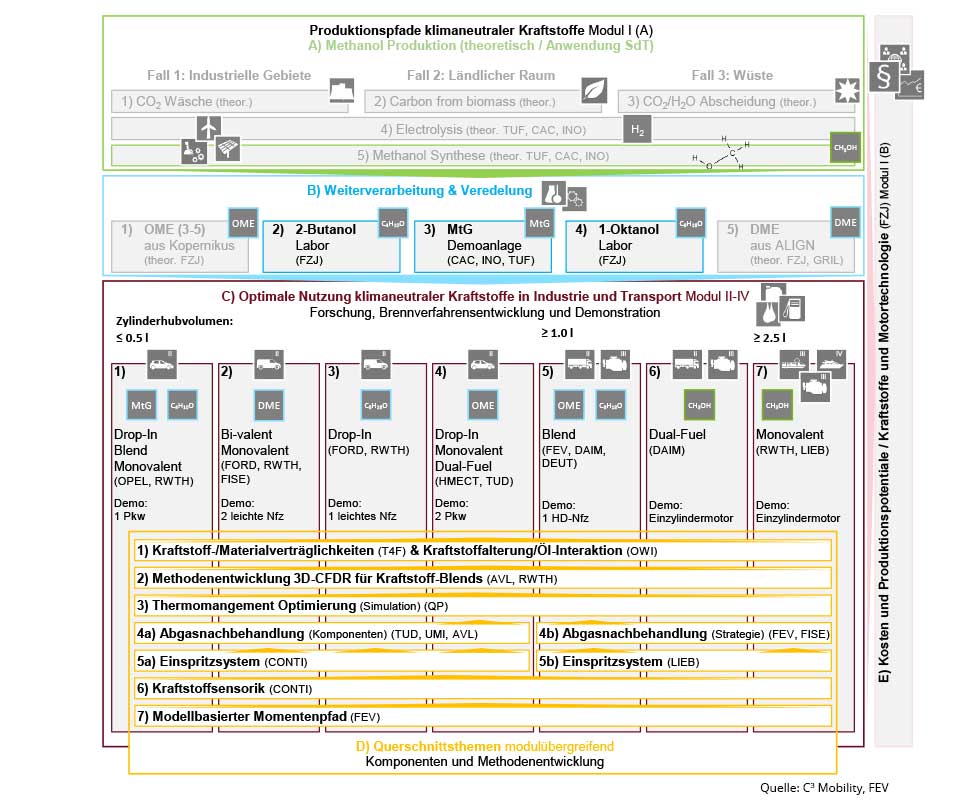
The joint project wants to develop and demonstrate new ways into the CO2-neutral mobility of the future. It refers to the funding announcement "Energy transition in transport: sector coupling through the use of power-based fuels" of the German Federal Ministry of Economic Affairs and Technology from spring 2017. To this end, a comprehensive consortium of 28 partners has been formed from all areas covered in the announcement in order to adequately address the issues described in their entirety to edit.
The most effective way to transport, store and use large amounts of energy in traffic is provided by liquid energy sources. In future, the use of regenerative fuel based on methanol will make the most sense. Besides its direct use as fuel, its (local) further processing should also be investigated. Furthermore, approaches are to be presented already today by adding stream-based fuels (drop-in fuel) to reduce fleet emissions. For this purpose, MtG (methanol-to-gasoline) is to be produced in a demonstration plant and its use in gasoline engines to be represented. In the diesel engine 1-octanol is available as drop-in fuel. For future applications, 2-butanol will be considered as drop-in fuel, octane booster and as pure fuel for gasoline engines and OME / DME taking into account the multi-fuel capability for diesel engines.
The vehicle suitability of the new fuels should be validated under real driving conditions; Their efficiency and their environmental compatibility are to be assessed holistically in the production and consumption chains as well as in sales and market introduction.
BSE supports the project through an associated partnership.
(Support Code: 19I18006, Duration: August 2018 - July 2021)
Partner